Newport Coast History, carefully understood

Newport Coast, California: A Documented History

A researched reference for the Indigenous land history, Rancho San Joaquin, Irvine Ranch, preservation battles, master planning, annexation, and real-estate identity behind Newport Coast.

Explore communities

Newport Coast history at a glance

Newport Coast began construction in 1990 and became part of Newport Beach in 2002.

The modern community is a coastal hillside district shaped by Indigenous land history, Rancho San Joaquin, the Irvine Ranch, Crystal Cove preservation, archaeological work, and master-planned residential development above the Pacific.

Modern development
Newport Coast began construction in 1990 and developed into a nearly 3,000-acre master-planned residential community.
Annexation
The area was annexed into the City of Newport Beach on January 1, 2002.
Historical pattern
Its modern value is tied to unified land ownership, protected open space, ridge-and-canyon geography, and controlled community planning.

Historical context

Newport Coast did not appear all at once. Its modern luxury identity sits on a much older coastal landscape.

Newport Coast is often described through its guard-gated communities, ocean-view homes, and proximity to Crystal Cove. That is the visible present. The fuller story begins earlier: with Indigenous coastal land, the rancho period, the Irvine Ranch, and a deliberate master-planned transformation of the hills above the Pacific.

Understanding that history matters because the same forces that shaped the land - open space, canyon edges, ridge lines, preserved views, and careful neighborhood planning - still influence how Newport Coast lives and how its real estate is valued today.

Timeline

From coastal land to a planned residential community.

Before European settlement

Indigenous coastal landscape

Before Newport Coast was mapped as residential villages and gated enclaves, the coastal hills, canyons, and nearby bluffs were part of a broader Indigenous landscape associated with Tongva and Acjachemen people.

1837-1864

Rancho San Joaquin

Rancho San Joaquin was granted in 1837 to José Andrés Sepúlveda. Its later sale to James Irvine and his partners became one of the key land-control events behind the Irvine Ranch.

Irvine Company

The Irvine Ranch

Newport Coast remained part of a vast centrally managed ranch holding, preserving unusually coherent ownership while much of coastal Southern California fragmented into smaller tracts.

1979-1988

Preservation and planning

Crystal Cove State Park, coastal open-space decisions, archaeological work, and late-1980s preservation compromises shaped where Newport Coast could and could not be built.

1990s

Modern Newport Coast

Residential construction began in 1990 as Newport Coast took shape as a nearly 3,000-acre master-planned community of connected villages above the Pacific.

2002

Annexed into Newport Beach

Newport Coast was annexed into the City of Newport Beach on January 1, 2002, while retaining its distinct coastal hillside identity.

Full article

The Documented History of Newport Coast

The overview above gives the quick answer. The full history below preserves the deeper record: Indigenous history, rancho ownership, the Irvine Ranch, Crystal Cove, preservation disputes, archaeology, master planning, annexation, and the real estate identity that followed.

Origins

Indigenous Land and Archaeological History

Newport Coast did not begin as a neighborhood. It began as a coastal landscape of ridges, canyons, bluffs, and creek mouths that had been used by Indigenous peoples for thousands of years before any modern map gave the area its current name.

The land that now includes Newport Coast and Crystal Cove sits within the traditional homelands associated in the historical record with the Tongva, also known as Gabrielino, and the Acjachemen, also known as Juaneño. Crystal Cove and preservation sources describe human presence in this coastal zone going back at least 9,000 years.

Archaeology later confirmed that the area was not an empty frontier before ranching and development. It was a lived-in landscape with settlement sites, food-gathering areas, and long cultural continuity. Any serious history of Newport Coast has to begin with that longer Native history.

Sources: Crystal Cove area history; Crystal Cove State Park; Crystal Cove Historic District

Rancho era

Rancho San Joaquin and the Irvine Ranch

Under Mexican rule, much of the land that would later become part of the Irvine Ranch was organized into large land grants. The most important of these for Newport Coast was Rancho San Joaquin, granted in 1837 to José Andrés Sepúlveda. Crystal Cove State Park's historical timeline identifies 1837 as the year Sepúlveda received the first grant covering the land that now includes Crystal Cove State Park. Irvine history materials describe Rancho San Joaquin as about 48,803 acres.

Sepúlveda lived the life of a Californio ranchero, but that system was vulnerable to forces outside his control. After the United States took California, Mexican landowners had to defend title through expensive legal proceedings. At the same time, the drought of 1862 to 1864 devastated cattle operations across the state.

Irvine history records say Sepúlveda could not recover from those losses and sold his 48,803-acre Rancho San Joaquin in 1864 for $18,000, or about 35 cents an acre. The deed distributed the purchase among James Irvine and his partners, with Irvine buying one-half and the balance divided among Benjamin Flint, Thomas Flint, and Llewellyn Bixby.

James Irvine and his partners assembled what became the Irvine Ranch in the mid-1860s, and Irvine later bought out his partners for $150,000, becoming sole owner of the enlarged ranch. Historical accounts describe a ranch that eventually stretched roughly 109,000 acres from the Santa Ana River to the Pacific Ocean.

That continuity of ownership mattered. It meant the future Newport Coast remained part of one immense, centrally managed holding rather than being subdivided early into smaller coastal tracts. Crystal Cove's timeline says 30,000 sheep grazed these hills in 1867 and 1868, and Irvine Ranch history later described the property as one of the great cultivated farms of California.

Sources: From Mexican Landgrant to Great Irvine Ranch; City of Irvine history; Irvine Company history; Irvine Ranch Conservancy history

Coast and access

Crystal Cove, Coastal Memory, and Jamboree Road

One of the few surviving pieces of the older coastline is Crystal Cove. Its history runs alongside Newport Coast's, but it does not mirror it. Crystal Cove State Park and preservation sources describe how the cove evolved into a casual recreational and cottage area in the early 20th century. People first camped there. Then cottages appeared, many built from salvaged or improvised materials.

Crystal Cove's official historical materials note that sometime in the 1920s a lumber ship capsized and usable wood drifted ashore, helping supply materials for more cottages. That detail helps explain why the cottage district developed with such an informal, vernacular character, so different from the carefully controlled architecture of later Newport Coast.

Crystal Cove also became a film location early on. State Park history notes that motion picture companies were using the cove by 1917 and that an early version of Treasure Island was filmed there in 1920. This gave the shoreline a modest but real cultural identity long before Newport Coast became a luxury address.

A surprisingly important precursor to modern development came in 1953, when the Irvine Ranch hosted the Boy Scout Jamboree on land near what is now Fashion Island. Los Angeles Times reporting states that Jamboree Road got its name from that event and that the Irvine Company graded an eight-mile gravel road to move scouts and supplies to the site. Separate reporting says more than 50,000 scouts attended.

Sources: Crystal Cove area history; Crystal Cove State Park; Crystal Cove Historic District; Crystal Cove Conservancy film history; Crystal Cove beach cottages; 1953 National Jamboree program; 1953 National Jamboree archive; How Jamboree Road got its name

Preservation

Preservation, Planning, and Archaeology

The modern Newport Coast story belongs primarily to the Irvine Company under Donald Bren. The Los Angeles Times records that a group including Bren bought the company in 1977 for $337 million, that Bren became majority owner in 1983, and that he became sole owner in 1996. Newport Coast as a built place is a Bren-era product.

In 1979, the State of California acquired the ocean-side portion of the Irvine Coast and created Crystal Cove State Park. Contemporary Los Angeles Times reporting described that acquisition as almost $34 million for about 2,300 acres between Coast Highway and the ocean. Later official and park sources consistently describe Crystal Cove State Park as 2,791 acres acquired from the Irvine Company in 1979.

The shoreline purchase did not end the fight over the broader Irvine Coast. By the 1980s, preservation groups were pushing for far more land to remain open, while the Irvine Company still sought to develop selected inland areas. A pivotal Los Angeles Times report from 1988 described the compromise that followed. It said trails would extend across more than 6,000 acres of contiguous open space and that only 1,600 acres of the remaining tract would stay private.

That compromise is one of the core facts in Newport Coast history. It explains why the district feels both developed and protected, why so many homes command preserved vistas, and why the area never became a continuous wall of coastal construction.

Development in the future Newport Coast area also triggered one of the largest and most significant archaeological programs in California coastal development. The Newport Coast Archaeological Project documented dozens of sites across the area. Los Angeles Times reporting on ORA-64 in 1997 described the site as one of the most important prehistoric sites remaining in Orange County and detailed the controversy over excavation, reburial, and preservation during the development process.

Additional archaeological scholarship on ORA-64 has since underscored its age and significance, including evidence that it ranks among the oldest shell midden sites on the Pacific Coast of North America. A polished luxury narrative that omits this chapter is not historically complete.

Sources: Irvine Company history; Los Angeles Times preservation agreement coverage; Crystal Cove State Park

Modern development

Development of Modern Newport Coast

Newport Coast is often discussed as though it sprang into existence fully formed, but the residential buildout came in phases. Los Angeles Times neighborhood reporting says Newport Coast began construction in 1990 and identifies it as a nearly 3,000-acre community of connected villages. That is a useful broad marker even though exact tract-by-tract sequencing is harder to pin down in one centralized public archive.

What can be said with confidence is that the earliest buildout came in the 1990s, with Newport Ridge and the first Newport Coast villages establishing the district as a scenic, master-planned coastal alternative to older Newport Beach neighborhoods.

The planning record is more nuanced than the single Newport Coast name suggests. Newport Ridge and Newport Coast were treated as separate planned communities or planning areas, while remaining historically and geographically linked within the same coastal hillside development pattern.

One of the clearest ways the Irvine Company shaped Newport Coast was through architecture. Orange County Business Journal reported in 2001 that the company mandated a European Mediterranean style and screened housing designs through its control process. That is historically important because it shows the look of Newport Coast was not an accident of buyer taste. It was part of the project's identity from the top down.

The Pelican districts became the most visible symbol of Newport Coast's ascent. They linked guarded residential prestige with golf, commanding topography, and resort-level image making. Pelican Hill's own timeline shows the resort broke ground in 2005, reopened its golf club in 2007 after redesign work, and opened to guests on November 26, 2008.

That opening mattered well beyond hospitality. It gave Newport Coast a globally legible luxury landmark and raised the district's profile from a regional high-end residential area to a destination recognizable in broader luxury travel and real estate circles.

Sources: Orange County Business Journal Newport Coast architecture; Pelican Hill timeline; Pelican Hill

City history

Annexation into Newport Beach and the Long Development Agreement

For much of its formative development period, Newport Coast was not within the City of Newport Beach. It was an unincorporated area governed through county approvals and agreements. That changed on January 1, 2002, when annexation became effective.

Newport Beach records confirm that date and show that the Newport Coast Advisory Committee was established to advise the city on implementation of the Newport Coast Annexation Agreement and issues relating to Newport Coast, Newport Ridge, and Crystal Cove. This helps explain why Newport Coast has always felt somewhat separate even after becoming part of Newport Beach. It is legally inside the city, but its governance history is different from older neighborhoods.

One of the easiest mistakes to make about Newport Coast is to assume it was built quickly in the 1990s and then finished. In reality, it has been a long-duration project. A 2016 Newport Beach resolution extending the Newport Coast development agreement states that the 2001 agreement covered approximately 7,799 acres along Newport Coast, that the property was annexed into the city on January 1, 2002, and that the agreement was extended because portions of the property remained undeveloped or underdeveloped.

That late-stage evolution included Fiano in Pacific Ridge. Orange County Business Journal reported that Fiano opened in 2015 as a 39-home development and later sold out, making it one of the final meaningful new-home additions in Newport Coast.

Sources: Newport Coast Advisory Committee records; Newport Coast annexation resolution; Newport Coast development agreement extension; Orange County Business Journal Fiano coverage

Present identity

Why Newport Coast History Matters to Real Estate

Newport Coast's current identity is partly a result of its documented physical characteristics and partly a product of market perception. The documented characteristics are clear enough: newer housing stock, heavier use of gates and private associations, a car-oriented layout, large amounts of adjacent preserved land, and a stronger degree of architectural control than in many neighboring coastal areas.

Relative to Corona del Mar, Newport Coast is usually seen as less walkable and less village-like, but more private, more controlled, and more insulated. Relative to Laguna Beach, it is often seen as less bohemian and less tourist-exposed, but more orderly and more security-focused. These are not official labels, but they are consistent with the differences in age, form, and planning history between the communities.

Historically, Newport Coast has not been a broad-based suburban housing market. It has always been a narrower, higher-ticket market where timing, presentation, architecture, privacy, and view quality matter. The same forces that shaped the land - protected open space, canyon edges, ridge lines, preserved views, and careful neighborhood planning - still influence how Newport Coast lives and how its real estate is valued today.

As of early 2026, Newport Coast's status is not just anecdotal. Realtor.com ranked ZIP code 92657, Newport Coast and Newport Beach, as the most expensive ZIP code in America in January 2026, with a median listing price of $12.5 million and average home size of 5,552 square feet. The Real Deal reported that 1 Pelican Crest Drive sold off market for $42 million in May 2025, making it Orange County's priciest recorded sale of that year at the time.

The sale should not be overread as proof of every Newport Coast value, but it does illustrate how mature trophy markets can price land position, address, privacy, view, and scarcity heavily, sometimes independent of the condition or design of the existing structure.

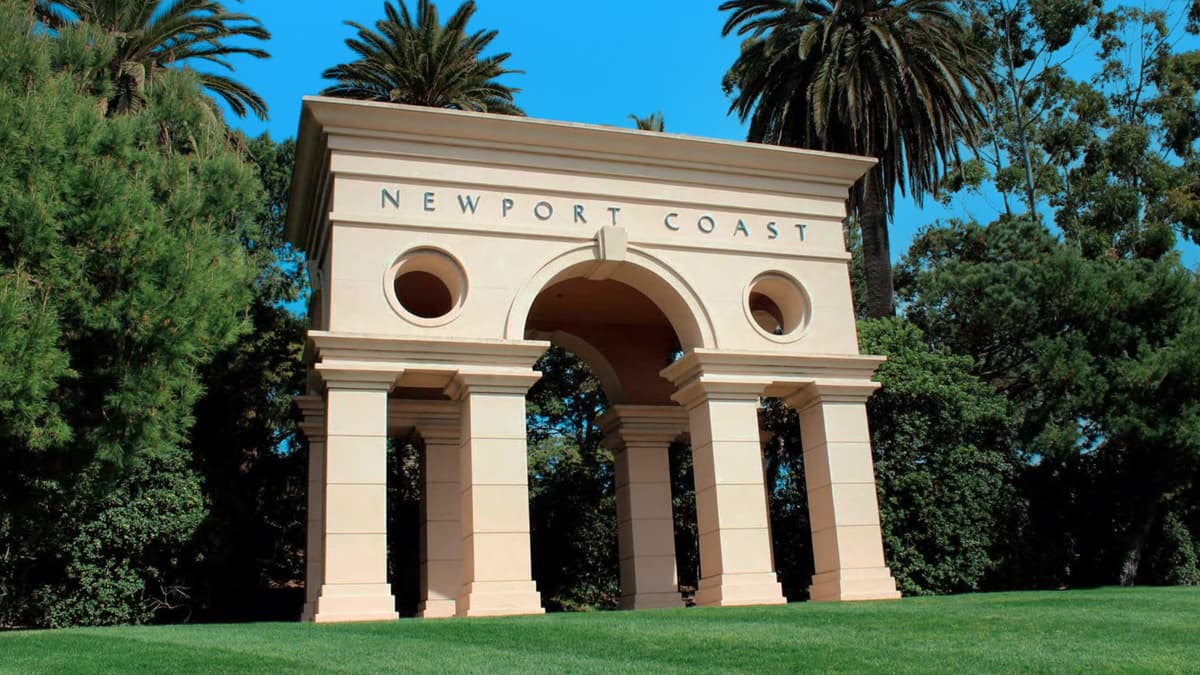
The most accurate way to understand Newport Coast is not as a simple luxury neighborhood, but as the outcome of an unusually long chain of land control and land-use decision-making. Its value does not come only from what was built there. It also comes from what unified ownership, public preservation, and strict planning kept from being built there.

Sources: Realtor.com 2026 research article; The Real Deal May 2025 Pelican Crest sale article

Newport Coast history FAQ

Frequently Asked Questions

When did construction begin in Newport Coast?

Newport Coast began construction in 1990 as a master-planned coastal hillside community organized around villages, open space, and residential neighborhoods.

When was Newport Coast annexed into Newport Beach?

Newport Coast was annexed into the City of Newport Beach effective January 1, 2002. It remains a distinct coastal area within Newport Beach.

What was the land used for before modern development?

Before modern residential development, the area was part of a broader Indigenous coastal landscape, later connected to Rancho San Joaquin and the Irvine Ranch. During the ranch era, the land was used for sheep, cattle, grains, hay, and other agricultural purposes.

What role did the Irvine Ranch play?

The Irvine Ranch kept the future Newport Coast within a large, centrally managed landholding. That continuity of ownership made later preservation, open-space planning, and master-planned residential development possible at a scale that would have been difficult on fragmented land.

Why does Newport Coast history matter for real estate?

The area's history explains its protected open space, ridge and canyon settings, coastal orientation, gated neighborhoods, architectural controls, and community-by-community differences that still influence value.

Is Newport Coast a separate city?

No. Newport Coast is not a separate city. It is part of the City of Newport Beach, although its annexation history and master-planned development pattern give it a distinct identity.

Keep exploring Newport Coast.

Move from the history into community guides, market data, resources, and the platform’s editorial standards.

Browse Resources